Availability and specifications may vary from country to country. Therefore, it is recommended to check with local sales representatives or dealers before final order.
All information applies to the German market.
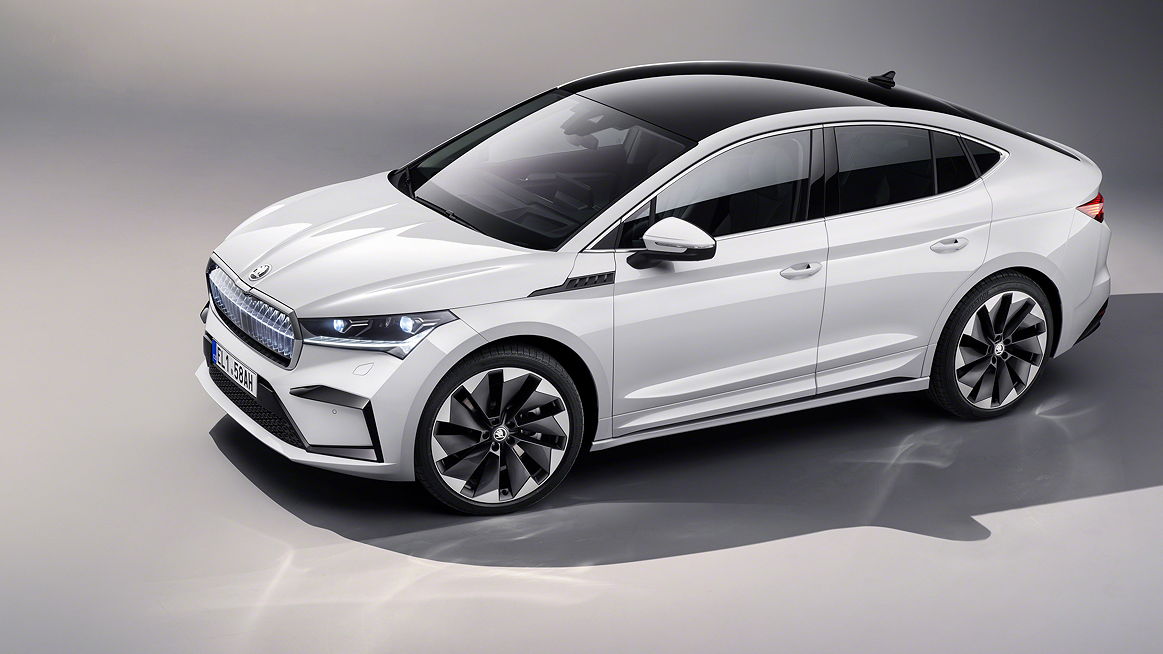
¹⁾ENYAQ COUPÉ iV: This is a concept vehicle that is not yet available as a production model..
²⁾Under certain circumstances, the maximum system power may not be fully available. The power available in individual driving situations depends on various factors, such as the ambient temperature, the charge level and the temperature, condition or age of the high-voltage battery.
³⁾Maximum electric power 195 kW: In accordance with UN-GTR.21, the maximum power which is available for up to 30 seconds. The power available in individual driving situations depends on variable factors such as the outside temperature or the temperature, charge status, condition and physical ageing of the high-voltage battery. The availability of the maximum power requires in particular a high-voltage battery temperature of between 23 and 50 °C and a charge level > 88%. As a result of deviations in the above parameters, power can be reduced or the maximum power may not be available. To a certain extent, the battery temperature can be indirectly influenced by the stationary air conditioning function and the charge level can be set in the vehicle. The power currently available is shown on the vehicle’s power display. In order to preserve the useful capacity of the high-voltage battery in the best way possible, a battery charging target of 80% is recommended for daily use (this can be changed to 100% prior to long journeys, for example).
⁴⁾Range determined on the chassis dynamometer according to the Worldwide Harmonized Light Vehicles Test Procedure (WLTP) in the most range efficient equipment variants for the models mentioned. The actual WLTP range figures can vary depending on the vehicle’s equipment. In practice, the actual range also varies depending on driving style, speed, use of comfort/ancillary features, ambient temperature, number of passengers/loading and topography.
The specified fuel consumption and emission data have been determined according to the measurement procedures prescribed by law. Since 1st September 2017, certain new vehicles are already being type-approved according to the Worldwide Harmonized Light Vehicles Test Procedure (WLTP), a more realistic test procedure for measuring fuel consumption and CO₂ emissions. Starting on September 1st 2018, the New European Driving Cycle (NEDC) will be replaced by the WLTP in stages. Owing to the more realistic test conditions, the…
Read Full Article Source