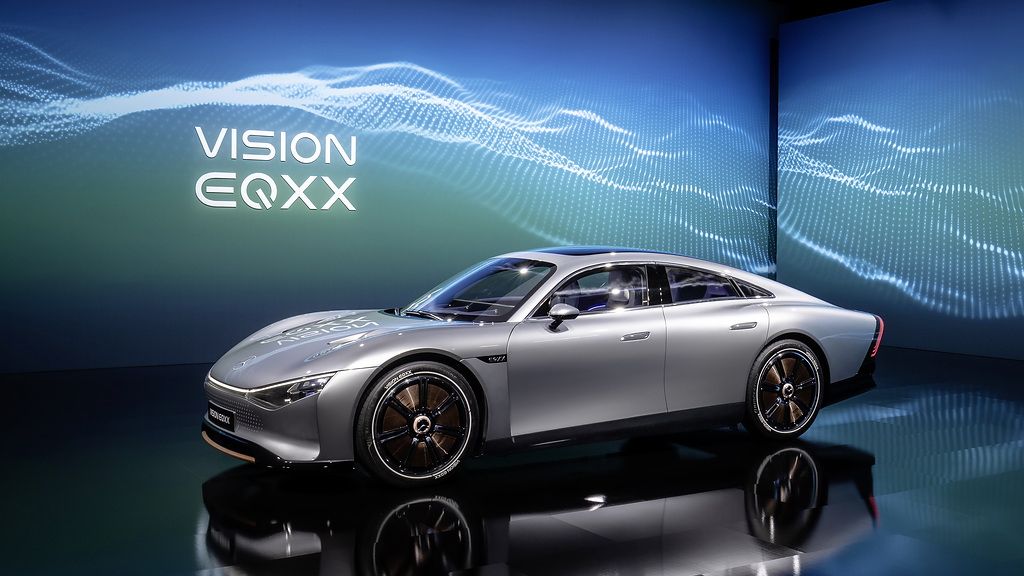
After launching some of the best luxury EVs in the market like the EQS and EQE, the EV division at Mercedes-Benz has set its sights on creating the most efficient and aerodynamic EV with the Vision EQXX concept. Unlike its other offerings, the EQXX concept will be the future of all EV offerings by the brand. With its slippery design and efficient powertrain, Mercedes claims that the EQXX can go 745 miles on a single charge, which is significantly higher than most EVs available in the market. The secret to this range is the teardrop design that makes sure there is minimal wind resistance.
The development time for the EQXX was surprisingly short, taking just 18 months since its inception in June 2020. The initial aim was to develop an EV capable of delivering 1000 km or 621-mile range on a single charge. To achieve this with a 100 kWh battery on board, the team had to attain an efficiency of 10 kWh/ 62.1 miles. Engineers from Mercedes’ Formula 1 and Formula E teams came together for the research and development of the EQXX.
The Race for Aerodynamic Efficiency
Just like with regular IC options, aerodynamic capabilities are just as important for EVs, especially for vehicles that focus on long range and performance. Less aerodynamic drag will result in less power being used, thus improving range. With the Vision EQXX, Mercedes has employed a teardrop design, resulting in a narrower rear and a smooth curve from front to rear. The rear track is two inches narrower than the front. Moreover, the cabin comes in a tapered design and you can find a long tail with an active diffuser that extends almost 8 inches.
All this effort has resulted in a drag coefficient of just 0.17, a significant jump over the 0.20 rating of the EQS. The Vision EQXX is easily the most aerodynamic car ever built, offering unrivaled efficiency. According to Mercedes, this design is not possible with standard IC cars owing to engine placement. With such a high focus on efficiency, Mercedes claims that over 62 percent of the EQXX’s efficiency comes from aerodynamics. Most of the parts are made of lightweight alloy or carbon fiber. You can also find a cooling plate underneath the car…
Read more atSource